

Travel Tips
President Obama Makes the Effort to Improve America’s Train System






 With Transportation Secretary Ray LaHood and Vice President “Amtrak Joe” Biden at his side, President Obama has begun a major push to reinvigorate America’s long-ailing train system.
Accordingly, Amtrak will receive $8 billion in funding from the stimulus package over the next two years to build what Obama has called “a smart transportation system equal to the needs of the 21st century.”
But travelers who have experienced the high-speed trains of Europe or Asia may be a bit disappointed by the proposal, which doesn’t envision speeds approaching those offered by the French TGV or the Japanese Shinkansen.
Yes, the building of new high-speed upgrades along existing designated high-speed corridors features prominently in this plan. But while the White House compared the announcement to President Eisenhower’s support of the interstate highway system, the $8 billion on offer is nowhere near the roughly $115 billion the federal government spent over 40 years to build interstate highways.
Still, the funding represents a significant investment in the American passenger rail system. Rod Diridon, the Executive Director of the Norman Mineta Transportation Institute, part of San José State University, was present at the announcement and called it “the most powerful and most cogent argument in favor of sustainable high-speed transportation” he’d ever heard.
Currently, only one high-speed line is in operation in the U.S.—the Acela Express, which covers the highly-trafficked East Coast corridor between Boston and Washington, DC, and reaches a maximum speed of 150 mph.
Though Vice President Biden had previously announced a near-doubling of Amtrak’s capital improvement budget to roughly $1.3 billion annually, the announcement today concerned the process of awarding competitive bids to the 10 designated high-speed rail corridors for upgrades and improvements.
A map of the designated corridors is below: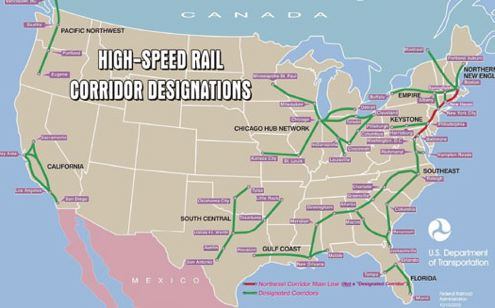
You can view a full-size PDF of this document here.
According to a number of studies of high-speed rail transportation around the world, the systems tend to work best in densely populated corridors around 100-500 miles in length. The Obama plan envisions something roughly similar, with most of the American corridors cited running 100-600 miles in length.
So with only $8 billion on offer and tens of billions likely needed to upgrade all 10 corridors, which ones are the most likely to receive the grants first?
According to Diridon, three projects were specifically mentioned in a call with the Transportation Secretary, former Republican Congressman Ray LaHood. LaHood indicated that those corridors in the most advanced stages of planning and environmental reporting were the most likely to get funding.
The three projects that are seemingly front-runners include:
- California’s proposed line from Sacramento to San Diego
- The Southeast line running south from Washington, DC through the Carolinas
- The Chicago Hub network, which connects its namesake with a number of nearby cities in the Midwest, including St. Louis, Detroit, Cleveland, and Madison
The example of California is instructive: In 2008, California voters approved almost $10 billion for a high-speed rail line stretching from Sacramento through the Bay Area and Los Angeles to San Diego.
 The total cost of the 800-mile line is estimated to be around $45 billion, leaving a yawning funding gap. But Diridon noted that the President promised that the funding was only a “down payment” on America’s commitment to its train system and that more matching funds from state and local governments would be used to obtain the federal cash.
In the interim, money from the federal government can be used to push the process in California forward and actually get construction started while the rest of the funding is put in place.
For now, though, much of the money is likely to be used to speed up existing trains and bring them up to the American definition of “high-speed,” which is officially 110 mph (by contrast, France’s TGV regularly hits 200 mph).
As an example, upgrades to the Chicago-Detroit route could raise speeds to about that level for a cost of around $1 billion, reducing travel time to about four hours from its current six.
While improving America’s trains has never seemed to be a higher political priority than it is now, it’s going to take more than this down payment to get Americans on board with truly high-speed trains.
By Matthew Calcara for PeterGreenberg.com.
Related links: New York Times, Reuters, CNN, Detroit Free-Press, Mineta Transportation Institute at San Jose State University, High-Speed Rail Corridor Designations
Related links on PeterGreenberg.com: