








 Upon hearing that engineers have successfully developed a “flying car,” there are usually many types of reactions, ranging from “Cool!” to “What took them so long?” to “Yeah, I’ve heard that before.”
In the case of the Moller m400 Skycar, the answer to the middle question is that it took Canadian engineer Paul Moller the better part of forty years (not to mention $200 million in development costs) to get to his current design.
But there are still plenty of problems with the m400, which is why competitors like the Parajet Skycar and Terrafugia’s Transition may bring the flying car dream to fruition more quickly.
Of course, for now and into the foreseeable future, a flying car is an expensive proposition. Moller’s prototype model was on sale on eBay with bids around $1.7 million before it was recently removed from the site.
Other options for flying cars may be a bit more affordable, but few are discussing anything under $100,000 at the very least. But for wealthy individuals, the skycar options are diverse, and some may represent a more workable vision for the idea of flying cars.
While Moller’s m400 Skycar can take off vertically like a helicopter, carry 4-6 passengers, and reach speeds of 375 MPH (or about 600 KMPH), it basically looks like a Formula One Car with giant engines on the sides and it isn’t suitable for driving on city streets – or anywhere else, really.
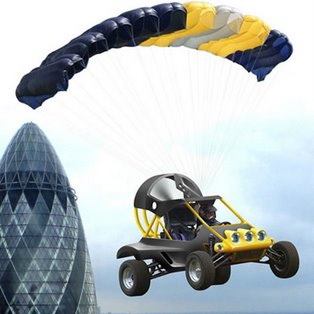 One alternative that fulfills the “car” part of the skycar concept is the Parajet Skycar (at right), which begins a high-profile expedition from London to Timbuktu in January 2009. This bio-fueled bird carries two people, resembles a hang-gliding dune buggy, and converts from “road mode” to “fly mode” in about three minutes.
While flying, it can purportedly manage to go about 65 MPH (or 110 KmPH), while on the road it can reach 110 MPH (or 180 KMPH). Its combined range is about 435 miles (700 km) and it can’t take off vertically like the M-400.
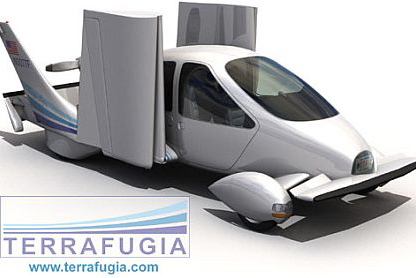 Then there’s Terrafugia’s Transition (at left), which like the Parajet Skycar, can convert from road to air modes and will theoretically be street legal. The Transition most closely resembles a light plane, but with retractable wings that turn it into a decidedly oddball-looking roadster.
The idea behind this vehicle is that you can park it in your driveway, drive it to an airport and then use airports to take off and land. The anticipated purchase price for a Terrafugia Transition is $194,000, according to its Web site.
Essentially, each flying car possibility is surprisingly dissimilar. The Terrafugia Transition is like an airplane you can drive to the airport, while the M-400 is more like a helicopter-plane combination designed for personal use. The Parajet Skycar seems to aim to be a car-plane hybrid that is a credible transportation option on both the road and in the air.
All three vehicles are bound only by their mutual hopes of being the model for the flying cars of the future. Whether anyone will be interested in getting one in the present is another matter entirely.
Related Links: MotorAuthority.com, Geek.com, Moller Skycar, Terrafugia, Parajet Skycar Expedition
By Matthew Calcara for PeterGreenberg.com.
Don’t miss the Future of Airport Security as well as Looking Into the Fare Future.
Learn more about air travel in our Airlines & Airports section.
Or get more of the latest travel news here.