


Travel News
The Sweetest Chocolate Tours: Good for the Body and Soul






 As Valentine’s Day approaches, many of you will dash off to a fine chocolatier for that perfect assortment of delicious, decadent chocolate.
But, as sweet as chocolate may be, many consumers don’t realize that most chocolate is made from cacao beans that are not sourced to specific farms.
The reality is, a large portion of the chocolate we savor comes from farms or plantations that rely on slave and child labor, so without being able to pinpoint the origin of the cacao beans, there’s no way to know if your chocolate has been tainted by forced labor.
So we tracked down some socially conscious chocolate tours and where you can buy those sweet, fair-trade treats for your special someone this Valentine’s Day.
SLAVE AND CHILD LABOR CONCERNS
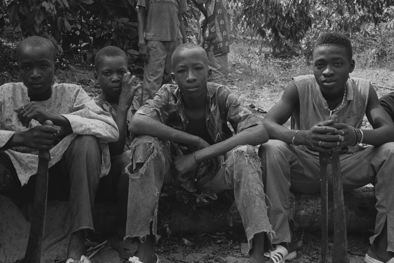
According to the international non-governmental organization Free the Slaves, the major chocolate companies, such as Hershey’s and Mars, have been spending millions of dollars voluntarily to clean up the industry and to establish, for example, rehabilitation shelters in Côte d’Ivoire for refugees who have escaped slavery. Photo: © Robin Romano
 However, the International Labor Rights Forum reports that many of these major chocolate companies failed to meet their July 2005 goals, for which they were to provide child labor-free chocolate and a monitoring and certification program. To date, these major companies have failed to implement any program that sources their cocoa to the farm level.
In a lecture at the University of Connecticut, Robin Romano, a photographer who extensively investigated slavery and child labor in Côte d’Ivoire, quotes an enslaved worker as saying, “Tell them when they are eating chocolate, they are eating my flesh.”
Indeed, over 40 percent of the entire world’s conventional chocolate is harvested from Côte d’Ivoire, and according to the International Institute of Tropical Agriculture, one million West African children drudge in the cocoa fields, only so we can appease our chocolate cravings.
 The first step in finding socially conscious chocolates is to look for the black-and-white Fair Trade Certified logo. Fair Trade certification means the cocoa has been purchased for a fair price from the farmer, creates direct trade links between farmer-owned cooperatives and buyers (cutting out the middlemen), and strictly prohibits slave labor.
As Anthony Marek, director of external communications for Fair Trade Certified, notes, “The grocery cart is the most important vehicle for social change.” Fair Trade Certification also promotes a variety of causes, including fairer prices for farmers, education for farmers’ children, and no child slavery.
It is also important to find chocolate sources that support biodiversity, sustainable practices, and the absence of unhealthy chemicals. Conventional farms or plantations are usually sun-grown and are dependent on pesticides. The preferable alternative is to source the chocolate from shade-grown cocoa farms, which, according to surveys conducted by Smithsonian researchers, benefits the soil’s quality, overall ecosystem health, and even promotes bird diversity in the region.
TAKE ACTION ON VALENTINE’S DAY
This Valentine’s Day, consider supporting a Fair Trade chocolate company, and pass along the V-Day concern by downloading a Valentine card from Organic Consumers Association. Through Global Exchange, you can participate in their National Valentine’s Day of Action by contacting at least five teachers in hopes of generating more awareness about Fair Trade initiatives among our nation’s youth.
TOURS
In an effort to rid the chocolate industry of slave and child labor and to sustain and conserve the environment, a handful of chocolate companies and farms have taken an active role in providing consumers with socially-conscious chocolate. Some companies even offer unique, hands-on learning tours.
Sweet Earth Chocolates
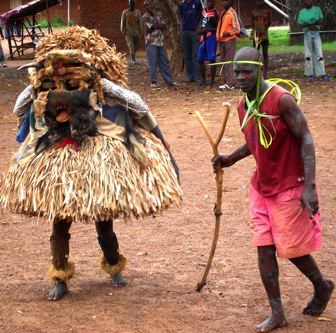 Mask Dance in Depa
© Tom Neuhaus
Tom Neuhaus is President of Sweet Earth Chocolates and Project Hope and Fairness (a non-profit organization dedicated to helping African cocoa farmers), and he also founded the Chocolate Enterprise Project at California Polytechnic State University in San Luis Obispo, the nation’s only chocolate production course.
His fervid passion for chocolate led him to create chocolate tours.
Tom’s favorite aspects of the tours are “singing and dancing with the villagers, drinking palm wine, having a breakfast schnapps by the still, playing with the children, and eating the fabulous food.” This cultural experience abounds with ethnic dishes, like chicken kedjenou (a stew made of free-range chickens), and ceremonies, like a mask dance performed by the village of Depa.
During the two-week tour, you visit 10 different villages: five located in Ghana and five in Cote d’Ivoire. You help donate tools to village chiefs and supplies—such as machetes and boots—to farmers and visit a cocoa buying company plant that dries the beans.
You also have the opportunity to hike to waterfalls in Soubre, walk through rainforests and swim in a river. The next tour will be offered this summer, and the tour costs $6,500, which includes all airfares, accommodations, care rentals, a guide, and even a $1,000 donation to a local village. 805-597-7213, www.projecthopeandfairness.org
Global Exchange 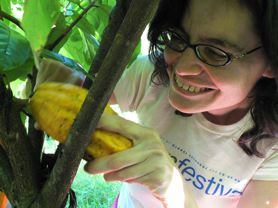
Although Global Exchange doesn’t offer a chocolate-exclusive trip, it is worth mentioning because it offers you a rare opportunity to live with a host family in a tiny community of 20 families, and you actually work alongside the villagers in Matagalpa, Nicaragua and help pick coffee beans for the harvest. At right, a volunteer in action. © Global Exchange
Don’t worry; this tour isn’t without some finger-licking chocolate treats!
At El Castillo del Cacao, guests tour this chocolate factory and learn about the process of making chocolate. And, guests spend a day picking cacao beans with a Fair Trade tour guide on a Fair Trade coffee cooperative. The tour, however, most heavily focuses on Fair Trade coffee farming and production.
You also take jungle trips, go on guided hikes in the mountains, forests, fields and farms, and venture into old goldmines, but watch out for bats! Many species of butterflies and birds, such as bright green parrots, take flight in this biodiversity haven, and swimming in waterfalls will offer you solace after picking coffee and cacao.
The tour also takes you to El Chile, where you watch artisans make fabrics and handicrafts. The lectures offered will teach you what a difference Fair Trade makes on health care for the community and how it transforms the lives of families in the area. 415-255-7296, www.globalexchange.org/tours
Yachana Gourmet Chocolate Tour
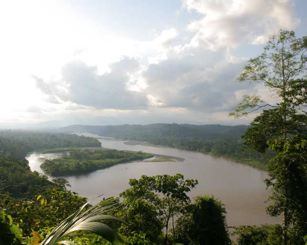 As a member of the Fair Trade Federation (an association of businesses and organizations dedicated to Fair Trade practices), Yachana Gourmet has been recognized for its sustainable development in the Amazon Region of Ecuador and rain forest conservation, and Condé Nast touts the Yachana Foundation’s Yachana Lodge as one of the world’s greatest examples of ecotourism.
View from a Yachana lookout point. © Yachana Gourmet
Yachana Gourmet also supports community health and fights poverty.
In Ecuador, the harvest season for cacao typically lasts from March to July, and if you stay at the Yachana Lodge, you can arrange to go on the Yachana Gourmet Chocolate Tour. During your stay, you may see parrots, herons, humming birds, and even toucans. You tour the production facility in Quito and learn about the process of how Yachana Jungle Chocolate is made, and here guests are not deprived of yummy chocolate tastings!
At the Saturday market, you view the purchasing of cacao from the local farmers. On the standard tour, you trek through the Amazon rainforest and see “wild” cacao trees. For an extra cost, you can schedule a special tour and visit small, local cacao farms and participate in the harvesting.
You also visit The Yachana Foundation’s Protected Forest and their biological research station, and you meet a local woman and learn about ceramic pottery-making, and you even can weave your own basked from locally collected fibers.
A four-day stay at the lodge is $480, and the specialized tours range from $100 to $400, depending on the activities in which the guests are interested. The production facility tour is free. 716-343-4490, www.yachanagourmet.com, www.yachana.org.ec
Discover Chocolate
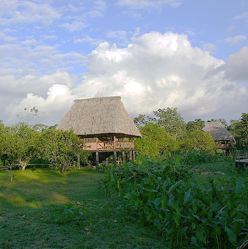 Discover Chocolate is certified by the Toledo Cacao Growers Association (TCGA)—the world’s first co-op to receive both organic and Fair Trade certifications. Run by Discover Chocolate, The Chocolate Lovers Travel Club takes place this May. Clay Gordon, the author of the book “Discover Chocolate,” is considered to be one of the world’s foremost experts on all things chocolate, and he leads the week-long tour in Belize.
You stay at the Cotton Tree Lodge (photo © Clay Gordon), an ecolodge that also is a member of the TCGA. Conveniently located, this lodge is less than 30 minutes from Punta Gorda, and you can travel to it by boat or car. It even offers Internet access in the main lodge for those of you who cannot afford to be disconnected. The cabanas offer peaceful views, and the lodge has over 500 young cacao trees on its property.
Although these trees aren’t ready to be harvested, the tour visits a local cacao farm, where you participate in a Mayan chocolate making workshop. Among the Toledo Cacao Fest activities, you enjoy the local food, visit markets, and stroll along the wharf. Classes on chocolate history and modern chocolate making are offered, and when you take a boat trip to Snake Caye, you can even drop-line fishing for snapper.
You visit Mayan ruins sites, take guided hikes, and go on canoe or kayak rides, and for those daring travelers, you even can rope-swing into a river. Keep in mind that this tour is family-friendly, so bring along the kids.
The price per person for double occupancy is $2,377, which includes round-trip airfare from Belize City to Punta Gorda, transfers, all-inclusive lodging, meals, scheduled optional tours, classes, chocolate tastings, and an autographed copy of “Discover Chocolate.” 914-671-0174, https://discoverchocolate.com/
RESOURCES
For those of you who would like to purchase chocolate for Valentine’s Day, as well as support Fair Trade initiatives, here is a list of slave- and child labor-free chocolate companies:
Cocoa Camino (Canada)
(613) 235-6122, www.cocoacamino.com
Divine Chocolate
(202) 332-8913, www.divinechocolate.com
Equal Exchange
(774) 776-7333, www.equalexchange.com
Ithaca Fine Chocolates
(607) 257-7954, www.ithacafinechocolates.com
Omanhene
(414) 744-8780, https://omanhene.com
Sweet Earth Organic Chocolate
(805) 544-7759, www.sweetearthchocolates.com
Theo Chocolate (offers factory tours)
(206) 632-5100, www.theochocolate.com
For more information on socially conscious products, such as coffee, chocolate, etc., here is a list of useful resources:
Organic Consumers Association
www.organicconsumers.org
International Labor Rights Forum
(202) 347-4100, www.laborrights.org
Fair Trade Certified
(510) 663-5260, www.transfairusa.org
Global Exchange
(415) 648-8068, www.globalexchange.org/
By Monique-Marie DeJong for Petergreenberg.com.
Really in love with both your sweetheart and the Earth? Don’t miss The Virtuous Traveler on Greener Honeymoons.
Check out the rest of our Responsible Travel section for more ideas on trips that are good for our planet, and its inhabitants.
Looking to take a vacation that’s truly fulfilling? Find out how with our Voluntourism page.