








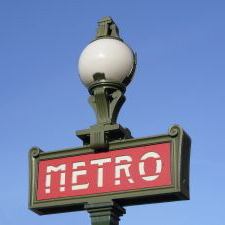
 Transportation in Paris is quite comprehensive, with a subway system (Metro), urban rail (RER), buses, suburban trains (Transilien), trolleys, bike stations, and night buses (noctiliens) running regularly.
And since it’s one of the world’s most pedestrian-friendly cities, there’s really no need to rent a car or stick to tour buses.
Paris and the surrounding region are divided into 6 different fare zones: Zone 1 being Paris itself, with Zone 6 being the furthest suburbs. A basic transport ticket will include zones 1 and 2, so the more zones you travel through, the more you have to pay.
The Metro
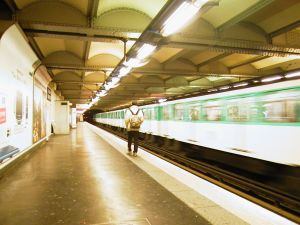 Since Paris doesn’t sprawl to the degree of most American cities, you can go practically anywhere in 20 to 45 minutes by taking the Metro. The Metro is also among the world’s easiest subway systems to use.
Just remember: the direction and name of the line are determined by the stations at each end. So for example, if you’re at Champs-Elysees Clemenceau and you want to go to Place de Clichy, you would look for the Saint-Denis–Universite line. However, keep in mind that most Parisians refer to the various lines by their respective number (Saint-Denis-Universite, for example, is line 13).
You can find stations in almost every single area of Paris. You only have to buy one ticket (at the station’s entrance) per trip, even if you have a transfer to make. It will cost you 1.5 euro (normal fare) if you buy just one ticket, and 11 euros if you buy 10. It’s probably a good idea to buy 10 if you’re going to be in Paris for more than a day or two, since the Metro is the most convenient form of transportation in most situations.
Video Tip: The Secret Spots of Paris
These tickets are used in all public transportation in zones 1 and 2. To go any further, you’ll actually be taking the RER (suburban trains), so ask for a ticket to your final destination at the ticket booth (located inside RER stations or at a railway station).
Usually, the first trains start at around 5:30am and the last ones stop at around 12:50am during the week, and 1:40 am on Saturdays or the night before a bank holiday. Be careful, the time depends on the station and the line, so be sure to check the schedules.
 Bus
Bus
Hundreds of bus lines are available all over Paris and its closer suburbs. The bus is widely regarded as being safer and cleaner than the Metro (at least among Parisians), but it is also much slower–although you could always use the time to take a look at the city.
Older people use it a lot, so be aware that you might get mean looks or remarks from them if you are young and/or loud, or don’t give up your seat for them. If you didn’t buy a ticket in the Metro, you can purchase a ticket (like the Metro, it’s 1.5 euros) from the bus driver. If you have a transfer to make, you’ll have to pay for another ticket.
For more information about traveling to Paris, check out Off the Brochure Travel Guide: Paris, France.
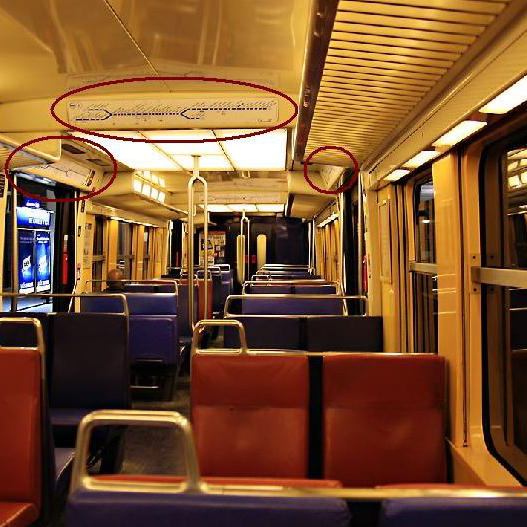 RER
RER
There are 5 RER lines: A, B, C, D and E. These are double-decker urban train lines that run through Paris and continue to the suburbs. The system is similar to the Metro, but stations are spaced further apart, with fewer stops. The RER can take you to Versailles (which is in zone 4), EuroDisney, and both major airports: Orly and Charles de Gaulle. Because the RER covers a lot of territory, including some of the city’s rougher suburbs (or “banlieues”), be cautious when traveling at night.
Trolley or “Le Tramway”
Added to Paris’s public transportation system recently, this system circles Paris, following the innermost of the two beltways. Four lines are available: T1, T2, T3 and T4. While they are considered clean and safe, they may not be useful for most visitors because they don’t reach popular destinations.
Learn globe-trotter fashionista Suzy Gershman’s Paris favorites in Suzy Gershman’s Postcard from Paris, The Encore
 The Night Bus or “Noctilien”
Unlike New York subway, the Paris Metro isn’t operational 24/7. So when the Metro closes, “les noctiliens” are a convenient alternative to taxis. Night buses in Paris are wide ranging and cover most areas of the city. However, they don’t stop in nearly as many locations as the regular buses, so you may have to do a bit of walking to get to your hotel if you take one. You can use a standard Metro ticket to take it, or purchase one from the bus driver if you don’t have one.
For more information on the transit systems above, please check www.ratp.fr (click on the British flag in the upper right-hand corner of the site to see it in English)
The Transilien or “train de banlieue”
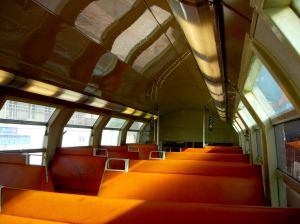 These trains depart from the 6 main railway stations in Paris (Gare Montparnasse, Gare St Lazare, Gare de Lyon, Gare de l’Est, Gare d’Austerlitz and Gare du Nord). These trains, which are similar to the RER, will take you to the farthest suburbs, even beyond zone 6. Therefore, they are more expensive and generally used by commuters. However, you can also go to far-flung attractions like Versailles with these trains.
For more information about the transilien go check the SNCF section on www.ratp.fr
Ride the rails far beyond Paris: visit our Train Travel section.
Bikes/Velib
This innovative “free bicycle” system was recently launched in July 2007. Look for long gray bike racks with an average of 20 bikes at each station. The Paris city government has installed these bike stations every 1,000 feet or so. You can buy a one-day pass for one euro with your credit card (you can’t pay in cash) and take a bike from the station. Once you have your pass, the first half hour is free, the second is one euro, the third is two euros, etc.
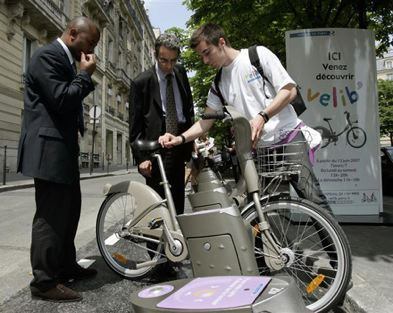 Now here’s the catch…because you have to use a credit card, Americans can run into issues. The readers only recognize credit and check cards with microchips, which a lot of Americans do not have. They’ve recently begun accepting Amex and international JCB cards issued in the States, regardless of whether or not they have a microchip. Alternately, if you don’t have one of these cards, if you have un ami in Paris, he or she can help you out.
So after riding for half an hour, simply put back your bike into the nearest station (it doesn’t have to be the one you took it from). You then can take another bike, so that you are only riding during the free half hours. This way, you can have a bike all day in Paris, and in the end pay only one euro for the day.
The city has a large number of bike paths, which make it really easy to bike, even with the traffic. But be careful—if you don’t give the bike back, or if it is damaged, your credit card will be charged 150 euros. More on Velib: www.velib.paris.fr
By Celestine Albert-Steward for PeterGreenberg.com. Celestine Albert-Steward grew up in the Montparnasse district of Paris.
Don’t forget to check out Ms. Albert-Steward’s Off the Brochure Travel Guide: Paris, France.
More Paris travel info:
- Ask the Locals City Guide: Paris, France
- Paris Restaurant Guide & Budget Travel Tips
- An American’s Guide to Etiquette in Paris
- A Guide to Layovers in Paris
- Interview with Monique Wells: African-American Paris
- Suzy Gershman’s Postcard from Paris, Part 1
- Suzy Gershman’s Postcard from Paris, The Encore
- Suzy Gershman’s Guide to Luxury Paris Hotels for Less
- The Secret Spots of Paris
- Touring France & the Tour de France
- Culinary Travel: A Single Woman Finds Love in Paris Cooking Schools